Almost a century after its signing, some aspects of the Treaty of Trianon remain under-researched. These include the question of refugees or the social experience of the collapse at the end of the war in Hungary. Balázs Ablonczy, leader of the „Trianon 100” research group at the Hungarian Academy of Sciences (HAS) also directs our attention to differences of meaning – Trianon means different things to the various Central European nations.
The HAS Momentum „Trianon 100” research group has undertaken to present and highlight the lesser known aspects of the Treaty of Trianon through monographs, special issues of journals, conferences and other instruments in the toolbox of popular science, said the leader of the project in conversation with the program Sigma – The World of Tomorrow, broadcast on InfoRadio.
Balázs Ablonczy thinks it unlikely that information will be uncovered which would fundamentally change our understanding about the circumstances of the Treaty of Trianon. At the same time, a score of subjects remain partially researched at best. This includes the question of refugees.
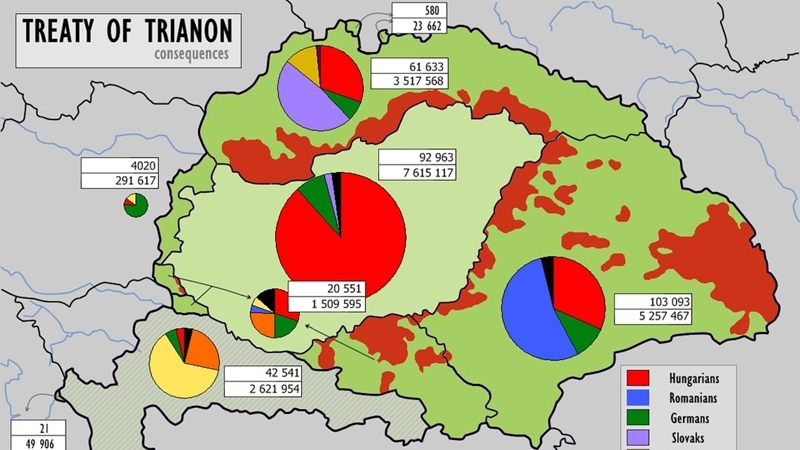
„Between 1918 and 1924, about 400-420 thousand people left the territories ceded to successor states, resettling in Hungary. Much about their integration, about their lives remains unexamined, constituting a debt for Hungarian historiography” – he added.
The leader of the research group also talked about the four chief dimensions of their work. One focuses on the publication of diplomatic sources, and includes collections of previously unpublished materials from the archives of Great Powers or related to the peace preparation process. The second focus is on the collapse at the end of the war and its effects on Hungarian society. This includes research on issues ranging from the availability of public goods and services, the fate of the armed forces and that of the aforementioned refugees.
Another aspect concerns the formation of the future borders, meaning the question of how the new frontiers were delineated on the ground, what economic ties they severed and what new relationships were forged as the result of their imposition. Finally, the fourth dimension is an investigation into everyday representations and memory. This would reveal the afterlife of the peace treaty in literature and art, as well. One of the prospective outcomes is a large, exhaustive database about Trianon memorials in the Carpathian Basin. Historiography and political discourse will also be investigated within this dimension of the project with regard to interpretations of the Treaty of Trianon.
Balázs Ablonczy also mentioned that there are researchers in Romania and Slovakia, with whom professional cooperation is proving productive, but some difficulties have also surfaced.
„One problem is, for instance, that the Treaty of Trianon is not an important issue in Slovakian historiography, which is understandable. The genesis of Czechoslovakia is important, but Trianon or the fate of the Hungarian minority is not in the forefront of research” – he explained.
The project leader observed that in Western historiography the Paris peace system after WWI was considered a popular topic once, but the Treaty of Trianon was analyzed, in this context, as part of a larger whole – the aforementioned peace system – and a monograph would often have perhaps one chapter devoted to it.
„Often, the problem consists in the fact that English-speaking or German or French authors simply do not know the languages or possess knowledge about all affected states that would enable them to really delve into the study of individual countries. They rely on secondary or even tertiary sources, using one or the other survey monograph reflective of the state of historiography some three or four decades ago. Those historians who do specialize in the subject and know languages spoken in our region usually approach the question in a top-down manner: there is a larger story, say the dissolution of the Dual Monarchy, and of course Hungary figures in that story, but they do no really engage with the Treaty of Trianon as a separate phenomenon” – the historian added.
Balázs Ablonczy emphasized as one of the goals of the research to place events and controversies in an international context and also look for parallels in Eastern European history.
The changes of the early 1990s, the dissolution of Czechoslovakia and Yugoslavia prove that the decisions about state formation were not thought through – the project leader opined, adding that new tensions were created in the region which have persisted alongside older conflicts.
„I do not think anyone would contest the legitimacy of the Polish desire for a separate state, so one finds well-founded decisions [in the peace system], but at the same time, the seeds of discord were sown and groundwork laid for future conflicts on many occasions. If one considers the Sykes-Picot agreement, which is having its 100th anniversary, we see that the redrawing of Middle Eastern borders, born out of a colonial, post-colonial mindset, created a considerable portion of the problems affecting the region today. The peace system also re-created some conflicts. On the other hand, there were also conflicts which it could resolve and among the outcomes [of the peace conference] we also find states and interstate relations which have proven more or less resilient and lasting.
András Domanits – InfoRadio