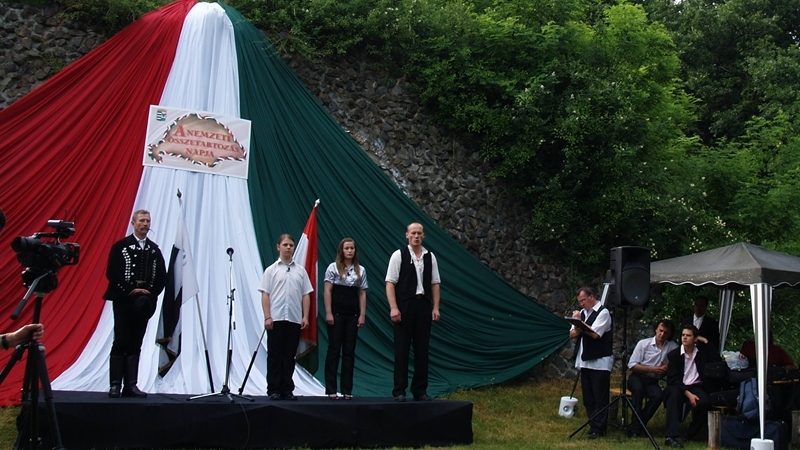
Issues related to the so-called “Trianon complex”—preoccupation with the disintegration of historical Hungary, the peace treaty that sanctified it and the consequences thereof— represent the subject of public discourse in some form or another in both Hungary and its neighboring countries. Moreover, these issues not only engage the attention of historians, intellectuals and, occasionally, political officials, but filter into everyday discourse as well (albeit often under the influence of opinion makers). The events themselves—the collapse of the Austro–Hungarian Monarchy, the political reorganization of the territory of the former dualist state and the new foundations underpinning relations between Hungarians and their neighbors—have been examined rather comprehensively, therefore the authors of the volume under consideration chose rather to investigate how Hungarians and Slovaks have remembered and continue to remember the Treaty of Trianon. That is, how do we interpret the treaty, how do we experience it, how do we recall it and think about it, how do we construct it and, finally, how do we pass this complex phenomenon on to subsequent generations? How does an event build itself into our lives that affects many people only distantly or indirectly and, furthermore, continues to draw farther away from us year by year, thus making our knowledge of it increasingly derivative?

The Disintegration of Historical Hungary signifies the conclusion of a multiyear Slovak–Hungarian project. Much of the content of the book is based on presentations held at a conference organized by the editors in Nové Zámky (Érsekújvár), Slovakia with the support of the Slovak Academy of Sciences and the Hungarian–Slovak Historians’ Mixed Committee in 2010. Some of these presentations have already been published in Hungarian,3 although The Disintegration of Historical Hungary in its present form is the product of long and thorough editorial process that has provided the Slovak reading public with a truly mature work. The composition of the authors in terms of nationality, age and academic discipline already provides an indication of the diversity of the book’s content: in addition to Slovaks, Hungarians and members of the Hungarian minority living in Slovakia, there is a French historian among the contributors, which include both the relatively young and well-known researchers as well as representatives from several subject areas—history, political science, sociology and didactics. Interdisciplinarity characterizes the entire volume; its contributors frequently show that they are not afraid to step out of their narrowly defined academic disciplines in order to utilize the methods and results of related fields of study. From the historian’s viewpoint, perhaps the most exciting aspect of the book is that it contains several approaches to the theme in question, varying from the “national” to the “analytical.” It is a tribute to the editors that this heterogeneity does not have a disturbing effect on the reader and does not pull the volume apart—the texts complement one another well and, in the end, present an organic unity. The final product cannot, however, be regarded as a monolithic whole, thereby more accurately reflecting reality in all its paradoxical aspects.
Go to full text of he review: Hungarian Historical Review 3, no. 2 (2014): 456-463.:
http://hunghist.org/images/volumes/Volume3_Issue_2/BookReviews.pdf
The book (Miroslav Michela – László Vörös (red.): Rozpad Uhorska a Trianonská mierová zmluva. K politikám pamäti na Slovensku a v Maďarsku. Bratislava: Historický ústav SAV, 2013.) may be downloaded at: http://forumhistoriae.sk/-/rozpad-uhorska-a-trianonska-mierova-zmluva