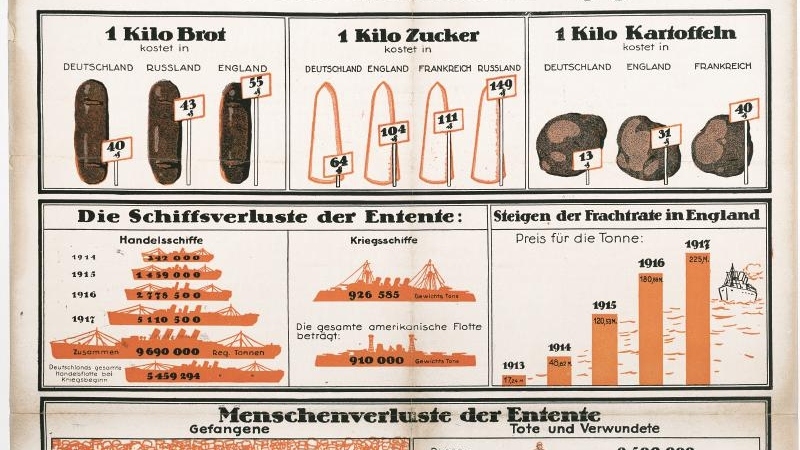
The question of nutrition may appear to be a banal one, yet this is a bias that is rooted in looking at the issue from the perspective of affluent societies and eras. A collection of studies tackled the question of the production and distribution of foodstuffs, as well as the societal and political conflicts they engendered in wartime years in the 20th century a good decade ago (Frank Trentmann – Just Flemming ed. Food and Conflict in Europe in the Age of the Two World Wars. Basingstoke: Palgrave Macmillan, 2006.). The market for foodstuffs and the political regulations governing it, however, is an important dimension in peacetime as well, impacting or determining the political behavior of affected groups, thus becoming a major factor influencing public life. (Cf. Frank Trentmann – Alexander Nützenadel ed. Food and Globalization: Consumption, Markets and Politics in the Modern World. Oxford and New York: Berg, 2008). During war, state control tended to increase especially over food production, which, as empirical evidence suggests, induced important shifts both in the internal relationships of the agrarian populace and its interactions with urban society (Cf. Yves Segers – Paul Brassley – Leen van Molle, War, Agriculture, and Food. Rural Europe from the 1930s to the 1950s. New York and London: Routledge, 2012). Most recently, the centennial of World War I, much as in other fields of research, inspired new work on the history of alimentation. (F.i. Rudolf Kučera, Rationed Life. Sciences, Everyday Life and Working Class Politics in the Bohemian Lands 1914-1918. Berghahn Books: New York – London, 2016.)
The nexus of alimentation and wars was the theme explored at the conference State and Food Supply during the Wars, 20th Century held at the Centre d’Histoire de Sciences Po in Paris, on November 25, 2016. While the sitting was convened by Alain Chatriot, its presenters and presentations included only a single French contribution, focusing on local politics of occupied northern territories of France during World War I. In these areas, production and consumption of foodstuffs was very much the central question of local politics, with municipal authorities having to manage the tension between provisioning the occupiers and satisfying local consumption needs.
Mexico was highlighted as a non-European case study thanks to Alejandro Tortolero Villasenor, who analyzed the food crisis of the civil war years (concurrent with WWI) and the transformation of land ownership structures in the country. Two researcher arrived from and discussed Italy, focusing on the impact of World War I on food production and its economic and political consequences on rural society. One of the two participants from the United Kingdom was Paul Brassley, a veteran of the field, who combined wit and in-depth research to give an entertaining, yet also enlightening talk. Two Polish researchers presented the case of occupied Poland during World War II, where, surprisingly, evidence suggests that the production of foodstuffs was prospering. (Robert Andrzejczyk is an expert on restitution, who conducts research as a civil servant while also teaching at a university.) Peter Moser, from Switzerland, discussed the issue of alcohol consumption in the context of periods of warfare. Universal economic and moral perspectives on the question of drinking were in such times further complicated by the dilemma whether it was acceptable to use plants that could be consumed as nourishment to produce alcoholic beverages. Certainly, wars transformed the practices of and the considerations around the production of alcoholic drinks.
Ernst Langthaler (Austria) compared, in a highly structured and methodical presentation, Austrian and British attempts at increasing the efficiency of food production during World War II, finding that the latter were both more successful and had a long-term impact on agriculture in the country. Zsombor Bódy, from Hungary, discussed the politicization of food production, distribution and consumption, which had been governed by the market prior to World War I. This led to conflicts between producers and consumers, but also between different consumer groups. This perspective permits one to interpret the Hungarian Soviet (without reducing it to a single explanation) as the dictatorship of urban workers as consumers of foodstuffs over the rural producers. Hence, the counterrevolutionary period after the Soviet saw an emphatic dismantling of the political structures of food provisioning and a return to the market model in alimentation.